
A complete breakdown from ingredient logic to actual effects
in almost all high-end hair oil , hair serums, and salon-grade care products. It’s repeatedly labeled with terms like “golden ingredient,” “Moroccan liquid gold,” and “repair powerhouse,” and its price is often significantly higher than ordinary plant oils. Many people are attracted by its reputation while simultaneously harboring doubts: Is it really that miraculous, or is it just a marketing gimmick?
If you only know argan oil from advertisements, your skepticism is perfectly reasonable. But if you look at it from the perspective of ingredient structure, hair needs, and long-term effects, you’ll find that argan oil’s long-term core position in the hair oil industry is not accidental, nor is it based on hype. Rather, it’s because it has precisely addressed the question of “what hair really needs” in several key dimensions.
This article isn’t meant to repeat vague conclusions like “argan oil is great,” but rather to systematically analyze why argan oil is considered a “golden ingredient” in hair oil , starting from its components. Once you truly understand these six reasons, you’ll have a clearer understanding of whether any hair oil claiming to contain argan oil is worth buying, suitable for you, and how to use it without making a mistake.
Before discussing “gold” in Part One, let’s first understand what argan oil is.
Argan oil comes from the fruit of the argan tree, which is unique to southwestern Morocco. It is not an industrially produced oil that has been mass-produced and rapidly replicated, but rather a naturally occurring plant oil with highly limited conditions. The argan tree grows slowly and has extremely high requirements for climate and soil, which is one of the main reasons why argan oil has long been limited in production and high in price.
From a compositional perspective, argan oil is not a “single-function oil.” It doesn’t excel in just one particular metric, but rather maintains a remarkably balanced performance across multiple key indicators. This balance is precisely what makes it extremely rare in the hair care industry.
The biggest fear in hair care is never “insufficient,” but rather “overdoing it.” Too much moisture will make hair flat, while too little will leave it feeling thin and unable to provide adequate protection. The value of argan oil lies in its ability to provide a stable and repeatable solution to this delicate balance.
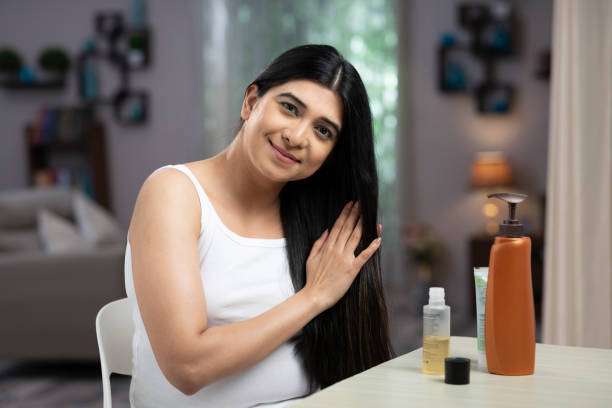
The second reason is that its fatty acid structure determines that it is “moisturizing but not greasy”.
hair oil containing argan oil for the first time have an immediate feeling that it flows smoothly without feeling heavy. This user experience is not due to some mystical phenomenon, but rather to the effect of the fatty acid structure.
Argan oil is richest in oleic acid and linoleic acid. The molecular structure of these two fatty acids is neither as heavy as that of coconut oil, nor as “slippery and insubstantial” as some light synthetic silicones. They spread very well and can quickly spread on the surface of hair to form a uniform and thin protective layer.
This structure allows argan oil to cover a large area of hair surface with a very small amount, thus reducing localized buildup. Because of this, it is less likely to create an “oily” feeling in the hair, a problem that many natural oils struggle to avoid.
This is especially important for those with fine, soft hair. Many plant oils aren’t lacking in moisturizing properties, but rather their molecules are too large, requiring a large amount to be effective; too much will cause the hair to flatten. Argan oil, on the other hand, has a natural advantage in being “effective in small amounts.”
The third reason is its extremely high compatibility with hair keratin.
The main structure of hair is keratin, and what keratin is most afraid of is not oil, but friction, moisture loss, and structural imbalance. Truly good hair oil is not simply “coated on the outside,” but provides protection without disturbing the keratin structure.
why argan oil performs consistently well in the hair oil market is its high compatibility with keratin. Unlike some highly occlusive oils, it doesn’t hinder the hair’s normal moisture exchange, nor does it increase friction due to uneven application.
use argan oil-based hair oils regularly often notice a change. It’s not that their hair suddenly becomes exceptionally smooth, but rather that breakage decreases and the pulling sensation when combing becomes lighter. This is a sign of good compatibility. It doesn’t create smoothness by “pressing down” the hair, but rather by allowing the hair to be less prone to damage in its natural state.
This effect is especially noticeable in people who frequently blow-dry, perm, dye, or style their hair. This is because once hair enters a state of high wear and tear, its “pickiness” towards oils increases dramatically, and argan oil is perfectly suited to adapt to this change in needs.
The fourth reason is that natural antioxidant capabilities allow repair to go beyond just the surface.
Among hair oil ingredients, few people pay attention to antioxidants, but they are crucial for long-term hair health. Although hair is “dead tissue,” its surface is still subject to continuous attacks from ultraviolet rays, air pollution, and high temperatures, all of which accelerate the aging of keratin structures.
Argan oil is rich in natural vitamin E and polyphenols, giving it excellent antioxidant properties. Unlike oils that simply provide lubrication, argan oil can, to some extent, slow down the rate at which external environmental factors damage the hair structure during use.
feel their hair is more resilient after using argan oil for a period of time. It’s not because the hair has been repaired to a brand new state, but because the rate of damage has been slowed down.
In the field of hair care, mitigating damage is often more important than repairing it afterward. And the antioxidant properties of argan oil fill this long-overlooked gap in the puzzle.

The fifth reason, reason four, is its high stability, which makes it suitable for long-term use.
Many natural oils work very well when first used, but problems arise after prolonged use, such as changing taste, becoming sticky, or experiencing inconsistent texture. This is often due to insufficient oxidative stability.
Argan oil is considered one of the more stable vegetable oils. Under normal storage conditions, it does not oxidize rapidly or undergo significant changes in texture with temperature variations. This is particularly important for hair oil .
Hair oil is a frequently used product, and if the experience is different each time it’s used, it’s easy to misuse the amount and end up with a problem. Argan oil’s stability allows it to maintain relatively consistent performance in different seasons and environments, which is why many professional hair oil formulas choose it as their core oil.
Stability is often an underestimated value. But for those who truly value long-term hair condition, it is precisely a prerequisite for being “useful”.
Part Six, Reason Five: Highly adaptable, rarely “picky about hair type”
Among all hair care ingredients, “suitability for different hair types” is a very real issue. Some ingredients are suitable for coarse and stiff hair, while others are only suitable for extremely dry hair. Using the wrong one can lead to a disastrous experience.
Argan oil is widely used largely because of its wide applicability. Whether it’s fine, soft hair, natural hair, slightly damaged hair, or moderately to severely damaged hair that is frequently styled, it can provide a positive experience when used in appropriate amounts.
This adaptability doesn’t mean it works the same for everyone, but rather that it has a high tolerance for error. Beginners are less likely to make mistakes, while experienced users have enough room to fine-tune the dosage and combination.
In the real world, the fact that an ingredient can be used by a large number of different groups of people for a long time without being eliminated is itself a manifestation of strength.
Part 7, Reason 6: It changes the “long-term state,” not the instantaneous effect.
The last reason, and perhaps the most easily overlooked, is that argan oil isn’t the kind of ingredient that makes you gasp in amazement the moment you apply it. Its benefits often aren’t fully apparent on the first day.
It primarily alters the long-term condition of the hair, such as the frequency of frizz, the speed at which split ends form, and the controllability after blow-drying. These changes will only gradually become apparent after continuous use for a period of time.
This is precisely why argan oil is not suitable for use as an “emergency product.” It’s more like a long-term partner than a temporary solution. This characteristic, in turn, gives it a very high level of positive word-of-mouth among those who truly understand hair care.
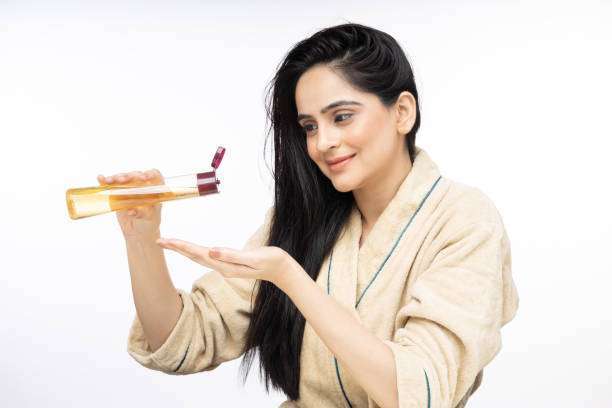
In conclusion, gold is not valuable because it’s expensive, but because it’s just right.
Argan oil is called the “golden ingredient” in hair oil not because it is rare, expensive, or has a good story, but because it perfectly meets the real needs of hair care in several key dimensions.
It’s not extreme, not flashy, and doesn’t pursue short-term dramatic effects, but it can consistently deliver stable and predictable improvements with long-term use. This quality is the most rare in the hair care industry.
Once you understand these six advantages of argan oil, you won’t be swayed by the mere presence of argan oil in various hair oil products. Instead, you’ll be able to judge whether it’s truly used appropriately within the overall formula. True hair care is never about blindly believing in ingredients, but about understanding them.
FAQ
Is
hair oil containing argan oil suitable for everyone? Argan oil has high compatibility, but the specific experience still depends on the overall formula and dosage. Even good ingredients may not be ideal if used incorrectly.
Question 2: Does a higher argan oil content mean a better
hair oil ? Not necessarily. An excessively high proportion may affect the overall texture and balance. Excellent hair oils prioritize synergistic formulations rather than simply piling on individual ingredients.
Question 3: Can pure argan oil be used directly as
hair oil ? Yes, but only in very small amounts, and it’s more suitable for moderate to severely dry or damaged hair. For fine, soft hair, a blended hair oil is usually more gentle.