Having worked in the hair care industry for many years, I’ve seen countless misconceptions about “repair,” and hair oil is one of the most common sources of these misunderstandings.
Almost every consultation involves someone asking the same questions: Why is my hair still dry, frizzy, and brittle even though I’m using hair oil? Why does other people’s hair look smooth and shiny with hair oil, while mine only becomes greasy and flat?
The problem isn’t whether you’re diligently caring for your hair, nor whether you’ve bought so-called “high-end” products, but rather a more fundamental issue: your understanding of “repair” may have been flawed from the start, deviating from the true logic of hair restoration.
Hair oil isn’t a scam, but it’s also not a miracle cure. The real problem is that we’ve placed it in a position it can’t fulfill. In this article, I want to explain five core truths about essential oils and repair from a professional perspective, helping you build a hair care understanding that you can use long-term without repeated trial and error.

Truth one: Hair oil cannot “repair” hair structure, but it can prevent further damage.
Many people first encounter hair oil after their hair is already visibly damaged. Frequent dyeing and perming, excessive heat styling, and dry environments cause hair to become rough, split, and easily broken, so we instinctively look for a “repairing product.” Hair oil is often given excessively high expectations at this point.
Structurally, hair is a fibrous tissue composed of keratin. Once the internal structure is broken, it doesn’t heal itself like skin. Hair oil cannot reverse existing structural damage; this is a fact that must be accepted. However, this doesn’t mean essential oils has no restorative value. Its true function is to prevent further damage.
When the hair cuticle is damaged, the rate of moisture loss increases significantly, the surface friction coefficient rises, and external pulling and impact are amplified. At this point, essential oils forms a stable protective layer on the hair surface, reducing friction and slowing down moisture evaporation, thus allowing the hair to enter a “maintainable” state. True recovery begins with stopping further damage. If you treat hair oil as a way to “fix what’s already broken,” you’ll be disappointed; but if you understand that it’s creating a favorable environment for hair recovery, its true value will become apparent.
Truth Two: The so-called “repair effect” is essentially a reconstruction of the hair’s surface condition.
Many people notice a significant change in their hair’s texture after using hair oil correctly for the first time – it becomes soft, smooth, and shiny. This experience is very real, but it can also lead to misunderstandings, making people think their hair has been “repaired.”
In fact, this change is not structural repair, but rather a reconstruction of the hair’s surface condition . When hair oil fills the gaps in the cuticle and smooths the arrangement of the hair scales, light reflection becomes more even, and the texture improves accordingly. This is a restoration of external appearance, not a regeneration of internal structure.
The problem is, if you don’t understand this, you can easily fall into “effect dependence.” If you stop using essential oils for a day, your hair condition will immediately deteriorate, leading to frustration and even the misconception that your hair has become worse. In reality, your hair has simply returned to its true state before surface management.
A truly mature approach to hair repair is to view essential oils as a stage-by-stage maintenance tool , not the ultimate solution. It’s responsible for stabilizing the external appearance, while internal recovery requires time, trimming, and basic care.

Truth Three: The premise of hair oil repair is not the ingredients, but whether the application method is correct.
In all the failed cases of using hair oil I’ve seen, the most common problem isn’t “buying the wrong product,” but “applying it to the wrong place.” No matter how expensive the hair oil ingredients are, if the application method is wrong, the repair effect will be completely negated.
The hair root area is where scalp sebum secretion is most active; it doesn’t lack oil, but rather balance. When essential oils is incorrectly concentrated at the roots, it not only fails to repair damaged areas but also disrupts the scalp environment, leading to limp hair, oil imbalance, and even affecting the growth of new hair.
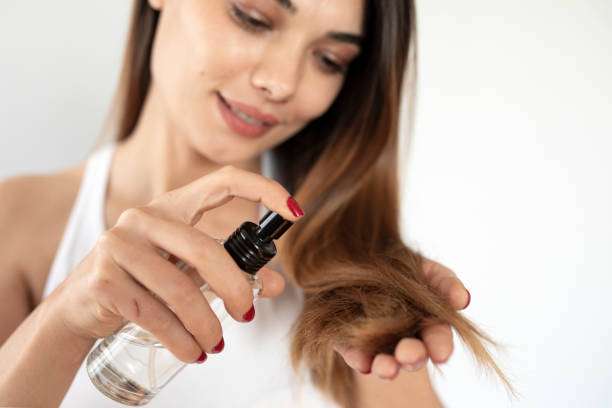
The area that truly needs hair oil is from the mid-lengths to the ends. This area is far from sebum supply, is the most concentrated area of damage, and where the true meaning of repair lies. When hair oil covers these areas along the direction of the hair strands, its protective function can be fully utilized.
If you find that you’ve used a good hair oil but your hair condition remains unstable, it’s highly likely that the problem isn’t the product, but rather a deviation in the repair method itself.

Truth Four: Different Levels of Damage Result in Completely Different “Repair Responses” to Hair Oil
Many people overlook an important fact: “damaged hair” is not a single, uniform concept. Mildly damaged, moderately damaged, and severely damaged hair react completely differently to hair oil.
For mildly damaged hair, the cuticle is only partially lifted, and the internal structure remains relatively intact. This type of hair often shows significant improvement after using essential oils correctly, with noticeable improvements in smoothness and shine, leading to the misconception that the hair is “completely repaired.”
For moderately damaged hair, the cuticle is disordered, and the ability to retain moisture is reduced. Hair oil acts more as a “stabilizer” in this case; it can improve the appearance, but requires continuous basic care to gradually restore elasticity.
For severely damaged hair, the internal structure is already broken, and a large amount of the cuticle is missing. Hair oil can only temporarily mask the roughness and make the hair look less terrible. This is not a failure, but reality. Expecting complete recovery at this stage will only lead to further disappointment.
Understanding the stage of damage your hair is in is crucial for determining the value of hair oil in the repair process.
Truth Five: True Recovery Involves Reducing Intervention, Not Constantly Adding More
This is the most easily overlooked, yet most important truth. Many people, upon realizing their hair is damaged, unconsciously enter “remedial mode,” constantly layering various hair care products, hoping to compensate for the damage with quantity.
However, for hair, excessive intervention is itself a new form of damage. If hair oil is repeatedly layered, forming a thick, heavy film, it will hinder the normal exchange of air with the hair, reduce tactile sensitivity, and even make the hair dull and inelastic.
What truly promotes recovery is moderate use and consistency after establishing the correct usage logic. When essential oils is applied only to the necessary areas and at the appropriate frequency, it can become an aid in the recovery process, not a burden.
Often, the improvement in hair condition is not because you “did more,” but because you finally stopped using the wrong methods.
From Repair Fantasy to Recovery Reality
When we consider these five truths together, we arrive at a very clear conclusion: hair oil is never the starting point of repair, nor should it be the end point of repair. Its true value lies in helping damaged hair maintain a manageable, stable condition and prevent further deterioration.
When you stop placing all your hopes on a single product and understand the role of hair oil within a comprehensive hair care system, true recovery can begin.
Hair recovery is never a miraculous overnight fix, but rather a process that requires proper understanding and patient treatment.
FAQ
Q1: Why does my hair look better after using hair oil, but revert to its original state when I stop using it?
This is because hair oil improves the surface condition of the hair strands, not the internal structure. Understanding this will prevent you from mistaking short-term effects for permanent repair.
Q2: Can I use essential oils every day on damaged hair?
Yes, but only if you use it sparingly and apply it correctly. Hair oil should be concentrated from the mid-lengths to the ends of the hair, not repeatedly applied to the roots.
Q3: Which is more important for repair: hair oil or hair mask?
They address different issues. Hair masks focus on replenishing and softening, while essential oils protect and stabilize. Truly effective repair comes from their combined use in the right places, not from relying solely on one of them.